
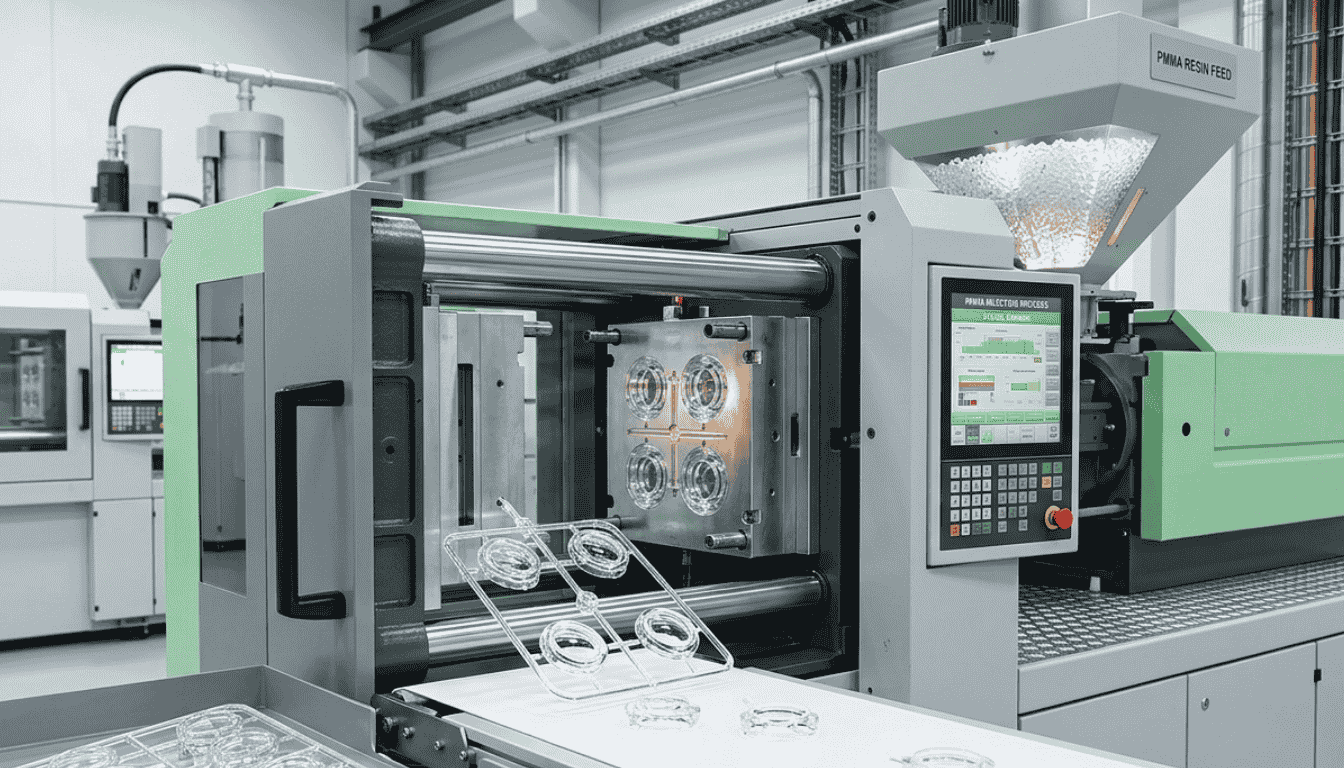
PMMA (Polymethyl Methacrylate), commonly known as acrylic, is a transparent thermoplastic widely used in applications requiring high optical clarity and surface quality. It is often selected as a lightweight alternative to glass in industries such as automotive, electronics, and medical devices.
Despite its advantages, PMMA is considered a relatively sensitive material in injection molding. It has a narrow processing window, is prone to thermal degradation, and can easily develop internal stress if not processed correctly.
This PMMA injection molding guide outlines the key process parameters, material characteristics, common challenges, and best practices required to achieve consistent, high-quality results—particularly for optical and aesthetic components.
What is PMMA Injection Molding Used For?
PMMA (Polymethyl Methacrylate) injection molding is primarily utilized for manufacturing transparent or semi-transparent components where optical performance, surface quality, and aesthetic appearance are critical design requirements.
The process enables the production of parts with high light transmission, low haze, and excellent surface finish, making it suitable for optical and visually exposed applications.
1. Common Applications
PMMA injection-molded components are widely used across multiple industries where clarity, UV stability, and surface durability are essential:
a. Automotive Components
Used in headlamp lenses, light covers, and signal housings where optical clarity, weather resistance, and dimensional stability are required under outdoor operating conditions.
b. Electronics and Consumer Products
Applied in display panels, transparent covers, and protective screens that demand high visual quality, scratch resistance, and consistent surface finish.
c. Medical Devices
Utilized for optical-grade housings and diagnostic components, where material transparency and chemical stability are important for functional reliability and inspection visibility.
d. Industrial Applications
Commonly used in light diffusers, protective shields, and instrument covers, particularly in environments requiring stable optical properties and resistance to environmental exposure.
2. Why PMMA is Selected
PMMA is selected based on its combination of optical and environmental performance characteristics, which are difficult to achieve with standard thermoplastics. Key material properties include:
a. High Optical Clarity
Light transmission up to approximately 92%, with low intrinsic haze, making it one of the most optically transparent thermoplastics available.
b. UV and Weather Resistance
Excellent resistance to ultraviolet degradation and outdoor exposure, maintaining transparency and color stability over time.
c. Surface Hardness and Scratch Resistance
Higher surface hardness compared to many other transparent plastics, resulting in improved resistance to abrasion and surface damage.
3. Limitations and Design Considerations
Despite its advantages, PMMA has inherent material limitations that must be considered during product design and application selection:
a. Brittleness and Low Impact Resistance
PMMA exhibits relatively low impact strength compared to materials such as polycarbonate, making it less suitable for applications involving mechanical shock or high-impact loading.
b. Sensitivity to Stress Concentration
Sharp corners, notches, or improper gate design can lead to crack initiation or stress whitening.
c. Processing Sensitivity
PMMA requires controlled processing conditions to prevent defects such as flow marks, bubbles, or optical distortion.
As a result, proper material selection, part design optimization, and injection molding parameter control are critical to achieving the desired optical and mechanical performance.
PMMA Injection Molding Process Overview
The injection molding process for PMMA (Polymethyl Methacrylate) follows the standard thermoplastic molding sequence; however, it requires significantly tighter control over processing parameters due to the material’s sensitivity to moisture, thermal degradation, and internal stress formation. Process stability is critical to achieving high optical clarity and minimizing visual defects.
1. Material Drying
PMMA is hygroscopic and must be thoroughly dried prior to processing to prevent moisture-related defects such as bubbles, silver streaks, and optical haze.
Typical drying conditions include:
a. Temperature: 80–90°C
b. Drying time: 3–4 hours (depending on material grade and initial moisture content)
Inadequate drying can lead to hydrolytic degradation during processing, resulting in reduced mechanical properties and compromised transparency.
2. Melting and Plasticizing
The dried PMMA resin is heated and plasticized within the barrel to achieve a homogeneous melt. Precise temperature control is essential to avoid thermal degradation, which can cause discoloration or gas formation.
Typical melt temperature range 220–260°C
Uniform melt preparation ensures consistent flow behavior and reduces the risk of flow-related defects in optically critical parts.
3. Injection into Mold
The molten material is injected into a precisely engineered mold cavity under controlled speed and pressure. For PMMA, injection speed must be optimized to balance flow front stability and minimize internal stress.
Key considerations:
a. Avoiding premature solidification during filling
b. Ensuring complete cavity filling without flow marks or weld lines
c. Maintaining a stable flow front to preserve optical quality
Gate design and placement are also critical to achieving uniform flow and minimizing visible defects.
4. Packing and Holding
After cavity filling, packing (holding) pressure is applied to compensate for volumetric shrinkage and to ensure complete replication of mold features.
Critical parameters include:
a. Holding pressure magnitude and duration
b. Gate freeze-off timing
Insufficient packing can result in sink marks or voids, while excessive pressure may introduce residual stress, leading to stress cracking or birefringence in transparent parts.
5. Cooling and Solidification
Controlled cooling is essential to achieve dimensional stability and minimize internal stress. Due to PMMA’s relatively low thermal conductivity, uniform cooling must be maintained across the mold.
Key factors:
a. Mold temperature control (typically 60–80°C)
b. Balanced cooling channel design
c. Avoidance of thermal gradients that can cause warpage or optical distortion
Improper cooling can lead to residual stress accumulation, which negatively affects both mechanical integrity and optical performance.
6. Ejection
Once the part has sufficiently solidified, it is ejected from the mold. Ejection must be carefully managed to prevent surface damage or stress-induced cracking.
Considerations include:
a. Proper draft angles
b. Optimized ejector pin placement
c. Controlled ejection force
For optical components, surface protection during ejection is especially critical to maintain visual quality.
7. Process Control Considerations
Each stage of the PMMA injection molding process must be tightly controlled to maintain optical clarity, dimensional accuracy, and surface integrity. Variations in temperature, pressure, or moisture content can directly lead to defects such as:
a. Flow lines and weld lines
b. Bubbles or internal voids
c. Silver streaks (moisture-related)
d. Residual stress and optical distortion
A robust process window, supported by proper material handling and mold design, is essential to consistently produce high-quality PMMA components.
PMMA Melting Temperature and Injection Molding Temperature
1. Temperature Control in PMMA Injection Molding
Temperature control is a critical process variable in PMMA injection molding due to the material’s relatively narrow processing window and sensitivity to thermal degradation. Precise thermal management across the plasticizing unit and mold is essential to ensure stable flow behavior, optical clarity, and dimensional consistency.
2. PMMA Thermal Behavior
PMMA exhibits a glass transition temperature (Tg) in the range of approximately 105°C, above which the material transitions into a softened, rubbery state.
While initial softening occurs around 160–200°C, higher processing temperatures are required to achieve adequate melt viscosity for injection.
However, excessive thermal exposure can lead to polymer chain degradation, resulting in discoloration, gas formation, and deterioration of optical and mechanical properties.
3. Recommended Injection Molding Temperature Range
To achieve optimal processing conditions, temperature settings must be carefully controlled across different zones:
a. Barrel Temperature: 220–260°C
Ensures complete melting and homogeneous plasticization of the material. Temperature profiling across zones should be gradual to avoid thermal shock.
b. Mold Temperature: 60–90°C
Higher mold temperatures improve surface replication and optical clarity, while also reducing residual stress and flow marks.
c. Nozzle Temperature: Slightly lower than the front barrel zone
Prevents drooling and material degradation at the nozzle tip while maintaining consistent melt flow.
Maintaining a stable thermal profile across these zones is essential to ensure consistent viscosity and flow front behavior during injection.
4. Temperature-Related Risks
Improper temperature control can directly impact both process stability and final part quality:
1. Excessive Temperature
Can cause thermal degradation of PMMA, leading to:
a. Yellowing or discoloration
b. Burn marks due to localized overheating
c. Gas generation, resulting in bubbles or voids
2. Insufficient Temperature
Results in inadequate melt flow, which may lead to:
a. Short shots or incomplete cavity filling
b. Weld lines due to poor flow front fusion
c. Increased internal stress from uneven filling
3. Process Stability Considerations
Maintaining a consistent and well-controlled temperature profile is essential for minimizing process variability. Key control strategies include:
a. Gradual barrel zone temperature distribution to ensure uniform melting
b. Stable mold temperature regulation to avoid thermal gradients
c. Synchronization between melt temperature and injection speed to maintain flow stability
A well-defined and controlled thermal process window is fundamental to producing PMMA components with high optical quality, minimal defects, and reliable performance in end-use applications.
Key Process Parameters in PMMA Injection Molding
PMMA injection molding requires precise control of multiple interdependent process parameters to achieve optimal optical quality, dimensional stability, and mechanical performance.
Due to the material’s sensitivity to thermal history and stress development, even minor deviations can result in visible defects or structural weaknesses.
1. Injection Speed
Injection speed directly influences melt flow behavior, flow front stability, and weld line formation. For PMMA, relatively higher injection speeds are typically preferred to promote smooth and continuous cavity filling.
Key effects:
1. Higher injection speed
a. Improves flowability and reduces the visibility of weld lines
b. Enhances surface replication and optical clarity
2. Excessive injection speed
a. Increases shear stress and localized heating
b. Can induce internal stress, leading to birefringence or stress cracking
C. May cause surface defects such as flow marks or jetting
An optimized injection speed profile often multi-stage is recommended to balance flow efficiency and stress control.
2. Injection Pressure
Injection pressure is required to overcome flow resistance and ensure complete filling of the mold cavity, particularly for thin-wall or complex geometries.
Key considerations:
1. Adequate pressure
a. Ensures full cavity filling and proper feature replication
b. Minimizes the risk of short shots and incomplete features
2. Excessive pressure
a. Leads to residual stress accumulation within the part
b. Increases the risk of stress-induced cracking and optical distortion
c. May cause overpacking, resulting in dimensional deviation
Pressure settings should be carefully aligned with injection speed and melt viscosity to maintain a stable filling process.
3. Cooling Time
Cooling time determines the solidification behavior of the material and has a direct impact on dimensional accuracy and internal stress distribution.
Key effects:
Sufficient cooling time
a. Ensures complete solidification before ejection
b. Improves dimensional stability and reduces post-mold shrinkage
Insufficient or uneven cooling
a. Can lead to warpage, distortion, and internal stress gradients
b. Increases the likelihood of optical defects such as haze or birefringence
Uniform mold temperature and balanced cooling channel design are critical to achieving consistent cooling across the part geometry.
Drying Conditions
Proper material preparation is essential, as PMMA is highly sensitive to moisture. Inadequate drying is one of the most common root causes of optical and structural defects.
Typical drying parameters:
a. Temperature: 80–90°C
b. Duration: 3–4 hours (depending on resin grade and moisture level)
Effects of improper drying:
a. Moisture vaporization during processing, causing bubbles or voids
b. Formation of silver streaks and surface defects
c. Degradation of optical clarity and mechanical properties
Consistent control of drying conditions is fundamental to maintaining process stability and ensuring high-quality output.
Process Optimization Perspective
These parameters are highly interdependent and must be optimized as a unified process window rather than in isolation. For PMMA, the primary objective is to:
a. Maintain stable melt flow with minimal shear-induced stress
b. Ensure uniform cooling to reduce residual stress accumulation
c. Preserve optical clarity by avoiding thermal and moisture-related defects
A robust parameter optimization strategy, supported by process monitoring and validation, is essential for achieving repeatable and defect-free production of PMMA components.
Common Challenges in PMMA Injection Molding
PMMA injection molding presents several processing challenges due to the material’s sensitivity to moisture, thermal degradation, and residual stress formation.
Most defects are directly associated with improper control of processing parameters, material preparation, or mold design. A clear understanding of defect mechanisms is essential to maintain optical quality and structural reliability.
1. Optical Defects
Optical defects are critical in PMMA applications, as they directly impact transparency and light transmission performance.
a. Bubbles (Voids)
Internal voids are typically caused by moisture vaporization, trapped air, or insufficient packing pressure. These defects reduce optical clarity and may compromise structural integrity.
b. Silver Streaks (Splay Marks)
Appear as streak-like patterns along the flow direction, primarily caused by moisture contamination or material degradation. Gas formation during injection leads to elongated surface marks.
c. Haze (Reduced Transparency)
Caused by internal stress, inconsistent cooling, or contamination. Haze results in reduced light transmission and poor visual quality.
Primary root causes:
- Inadequate material drying
- Moisture contamination
- Unstable melt temperature or injection speed
2. Thermal Defects
Thermal defects occur when PMMA is exposed to excessive temperature or prolonged thermal residence during processing.
a. Burn Marks
Localized overheating due to trapped air, high shear rates, or poor venting. Typically observed at the end of flow paths or in poorly vented areas.
b. Yellowing (Discoloration)
Caused by thermal degradation of the polymer, often due to excessive barrel temperature or long residence time in the injection unit.
Primary root causes:
- Excessive processing temperature
- Poor mold venting
- Prolonged material residence time
3. Structural Issues
Structural defects are primarily related to residual stress and non-uniform shrinkage behavior.
a. Internal Stress Leading to Cracking
Residual stress accumulated during molding can lead to stress cracking, either immediately after ejection or during service life. This is particularly critical for transparent components.
b. Warpage (Distortion)
Caused by uneven cooling, non-uniform wall thickness, or imbalanced packing. Differential shrinkage results in geometric deformation.
Primary root causes:
1. Non-uniform mold temperature distribution
2. Excessive packing pressure
3. Poor part design with stress concentration features
4. Flow-Related Defects
Flow-related defects are associated with melt flow behavior and cavity filling dynamics.
a. Weld Lines (Knit Lines)
Form when multiple flow fronts meet but do not fully fuse, resulting in visible lines and reduced mechanical strength at the interface.
b. Short Shots (Incomplete Filling)
Occur when the molten material fails to completely fill the mold cavity, leading to incomplete parts.
Primary root causes:
- Low melt temperature
- Insufficient injection speed or pressure
- Poor gate design or restricted flow paths
Engineering Perspective
Defects in PMMA injection molding are typically the result of interactions between material condition, process parameters, and mold design. Effective mitigation requires a systematic approach, including:
a. Strict control of material drying and moisture content
b. Optimization of processing parameters within a stable process window
c. Proper mold design, including gate location, venting, and cooling system
A data-driven approach, such as process monitoring or Design of Experiments (DOE), is often required to achieve consistent optical quality and defect-free production.
Best Practices for PMMA Injection Molding
Achieving high-quality PMMA injection-molded components requires strict control over material handling, mold design, processing conditions, and post-processing.
Due to PMMA’s sensitivity to moisture, thermal degradation, and residual stress, best practices must be consistently applied across the entire production workflow.
1. Proper Material Handling
Effective material preparation is essential to prevent moisture-related defects and ensure consistent processing behavior.
a. Controlled Drying Process
PMMA must be thoroughly dried prior to molding to eliminate moisture that can cause bubbles, silver streaks, and optical haze. Drying conditions should be maintained within a controlled range (typically 80–90°C for 3–4 hours).
b. Moisture-Controlled Storage
After drying, material should be stored in sealed or dehumidified conditions to prevent reabsorption of moisture. Prolonged exposure to ambient humidity can significantly degrade material quality before processing.
2. Optimized Mold Design
Mold design plays a critical role in achieving optical clarity, minimizing defects, and ensuring process stability.
a. Polished Mold Surfaces
High-gloss mold finishes (e.g., SPI-A standard) are required for optical-grade components to ensure maximum transparency and surface quality.
b. Effective Venting Design
Proper venting is necessary to allow trapped air to escape during injection, reducing the risk of burn marks and incomplete filling.
c. Uniform Wall Thickness
Consistent wall thickness minimizes differential shrinkage, reducing the likelihood of warpage, sink marks, and internal stress concentration.
d. Optimized Gate Design and Location
Gate placement should promote uniform flow distribution and minimize weld lines in visually critical areas.
3. Controlled Processing Conditions
Stable and well-optimized processing parameters are essential to maintain material integrity and product quality.
a. Temperature Stability
Maintain consistent barrel, nozzle, and mold temperatures within the defined processing window to ensure uniform melt viscosity and prevent degradation.
b. Avoidance of Overheating
Excessive thermal exposure can lead to yellowing, gas formation, and reduced mechanical properties. Residence time in the barrel should be minimized.
c. Balanced Injection Parameters
Injection speed and pressure should be optimized to achieve complete filling while minimizing shear-induced stress and optical distortion.
Process monitoring and parameter consistency are key to reducing variability and ensuring repeatable results.
4. Post-Processing (Annealing)
Annealing is often applied to PMMA components to relieve residual stress generated during the molding process, particularly for optical or load-bearing applications.
Purpose of Annealing
a. Reduces internal stress and risk of stress cracking
b. Improves dimensional stability over time
c. Enhances optical performance by minimizing birefringence
Typical Annealing Conditions
Components are heated to a controlled temperature below the glass transition temperature (typically 70–90°C), held for a defined period, and then cooled gradually to avoid introducing new stress.
Annealing is especially recommended for parts subjected to mechanical loads, chemical exposure, or long-term environmental stress.
Engineering Perspective
Consistent implementation of these best practices is essential for maintaining process stability and achieving high-performance PMMA components. The integration of proper material handling, optimized mold design, controlled processing, and stress-relief techniques enables manufacturers to:
a. Minimize defect rates
b. Maintain optical clarity and surface quality
c. Ensure long-term mechanical and dimensional reliability
A systematic, process-driven approach is critical for meeting the stringent requirements of optical and precision applications.
Design Considerations for PMMA Parts
Designing components for PMMA injection molding requires careful consideration of material behavior, particularly its sensitivity to stress concentration, flow characteristics, and thermal history.
Proper design optimization is essential to achieve high optical quality, dimensional stability, and long-term structural reliability.
1. Minimizing Stress Concentration
PMMA is inherently brittle compared to other engineering plastics, making it highly sensitive to localized stress.
Avoid Sharp Corners
Sharp internal corners act as stress concentrators and significantly increase the risk of crack initiation.
a. Recommended practice: Apply fillets or radii to distribute stress more evenly
b. Improves both mechanical integrity and mold filling behavior
2. Uniform Wall Thickness
Consistent wall thickness is critical to ensure uniform cooling and shrinkage behavior.
Maintain Uniform Sections
Variations in wall thickness can lead to differential cooling rates, resulting in:
a. Warpage and dimensional distortion
b. Internal stress accumulation
c. Optical defects such as haze or birefringence
Gradual Transitions
When thickness changes are unavoidable, transitions should be gradual to minimize stress concentration and flow disruption.
3. Flow Path Optimization
PMMA has relatively limited flowability compared to some other thermoplastics, making flow path design a critical factor.
a. Minimize Long Flow Paths
Excessively long flow lengths increase the risk of:
- Premature solidification
- Incomplete filling (short shots)
- Weld line formation
b. Balanced Flow Distribution
Proper part layout and runner design should ensure uniform flow front progression across the cavity.
4. Gate Design and Location
Gate design has a direct impact on flow behavior, weld line formation, and visual quality.
a. Optimized Gate Placement
Gates should be positioned to:
- Promote uniform filling and reduce flow hesitation
- Minimize weld lines in optically critical or high-stress areas
- Ensure balanced pressure distribution across the part
b. Gate Type Selection
Selection of appropriate gate types (e.g., edge gate, fan gate) can improve flow characteristics and reduce visible defects.
PMMA injection molding requires a higher level of process control compared to many other thermoplastics. Its sensitivity to temperature, moisture, and stress makes it less forgiving but highly valuable for applications requiring optical clarity and superior surface finish.
Achieving consistent, defect-free PMMA components depends on the integration of proper material handling, optimized mold design, and precise control of processing parameters.
Rather than relying on post-production correction, manufacturers should focus on preventing defects through a structured engineering approach from the early design stage.
Technical Consultation & RFQ Support for PMMA Injection Molding
For OEMs and product developers working with transparent plastic components, early collaboration with an experienced manufacturing partner is essential to ensure optical quality, structural integrity, and production efficiency.
By engaging in technical discussions during the early development stage, key factors such as material selection, wall thickness design, mold surface quality, and processing conditions can be properly evaluated before tooling investment begins.
Banshu Plastic Indonesia supports PMMA injection molding projects through a structured engineering approach, including Design for Manufacturability (DFM) analysis, material selection guidance, and precision mold engineering. This ensures that optical components can achieve high transparency, minimal internal stress, and consistent production quality.
Engineering teams and procurement professionals can submit 3D drawings for technical feasibility review or request RFQ support to evaluate suitable materials, tooling strategies, and production scalability.
For technical consultation or to discuss your PMMA component requirements, contact our engineering team to initiate a DFM evaluation and explore manufacturing solutions tailored to your project needs.